In high-temperature boiler furnaces, kilns, biomass combustors, and incinerators across Kenya, refractory firebricks form the primary structural shield protecting the steel shell and boiler tubes from direct flame impingement.
Yet in plant after plant—from tea processing factories in Kericho to sugar mills in western Kenya—newly installed refractory linings frequently suffer catastrophic damage within days of commissioning.
A maintenance team completes a major boiler overhaul, installs dozens of new high-alumina firebricks, turns the burner onto high fire, and within forty-eight hours, the furnace floor is littered with cracked, fractured, and pulverized brick fragments. Large chunks of refractory have literally sheared away from the wall, leaving the raw boiler tubes exposed to 1,300°C combustion gases.
The post-mortem report usually blames "defective bricks."
In 95% of cases, the bricks were flawless. The failure was caused entirely by thermal shock and improper dry-out procedures.
Understanding the physics of thermal spalling, the dangerous steam vaporization curve of chemically bound water, and how to execute a controlled multi-stage heating dry-out schedule is the difference between a refractory lining that lasts five years and one that fails in five days.
The Physics of Thermal Shock & Spalling
Refractory firebrick is a dense, highly crystalline ceramic material designed to withstand high temperatures under mechanical compression. However, ceramics possess two inherent physical weaknesses: low tensile strength and low thermal conductivity.
When a cold firebrick is subjected to sudden, intense heat:
                  THE MECHANICS OF THERMAL SPALLING:

        HOT FACE (Combustion Side: Rapidly Expands)
      ┌──────────────────────────────────────────────┐
      │  //////////////////////////////////////////  │  <-- Compressive Stress
      ├─ ─ ─ ─ ─ ─ ─ ─ ─ ─ ─ ─ ─ ─ ─ ─ ─ ─ ─ ─ ─ ─ ─ ┤
      │                                              │  <-- INTERNAL SHEAR CRACK
      ├─ ─ ─ ─ ─ ─ ─ ─ ─ ─ ─ ─ ─ ─ ─ ─ ─ ─ ─ ─ ─ ─ ─ ┤      (Parallel to Hot Face)
      │                                              │  <-- Tensile Stress
      └──────────────────────────────────────────────┘
COLD FACE (Steel Shell Side: Still Cold)- 1Steep Thermal Gradients: The hot face of the brick facing the flame rapidly reaches 800°C to 1,000°C and expands. The cold face, just 115 mm away against the steel wall, remains at 50°C.
- 2Internal Shear Plane: The rapidly expanding hot surface is restrained by the cold, unexpanded rear section. This generates massive internal shear stresses parallel to the hot face.
- 3Spalling Failure: When internal shear stress exceeds the refractory’s mechanical modulus of rupture, a crack propagates through the brick. The entire front 25 mm to 50 mm face of the brick shears off in a single slab—a failure known in masonry engineering as thermal spalling.
The Explosive Danger: Steam Expansion in Green Masonry
While rapid heating alone causes thermal shock, heating "green" (newly laid) refractory rapidly causes an even more violent phenomenon: explosive steam spalling.
When firebricks are laid with refractory wet mortar, or when dense refractory castable is poured, the masonry absorbs liters of water. This water exists in two distinct forms:
- •Free Physical Water: Liquid water filling the micro-pores of the brick and mortar joints.
- •Chemically Bound Hydrate Water: Molecular water bound into the chemical crystalline structure of hydraulic refractory cements (calcium aluminate hydrates).
                  PHYSICAL VS. CHEMICALLY BOUND WATER REMOVAL:

   Stage 1: Ambient Curing (24 Hours) ──► Complete hydraulic cement bonding
   Stage 2: 100°C - 120°C Hold ─────────► Free pore water boils & vents safely
   Stage 3: 350°C - 450°C Hold ─────────► Chemical crystalline water breaks free
   Stage 4: Final High-Fire Sintering ──► Ceramic bonds fuse permanently (>800°C)
If you fire a cold boiler rapidly past 100°C, liquid water trapped deep inside the brick matrix boils into steam. Steam expands to more than 1,600 times the volume of liquid water.
Because high-density firebrick has low gas permeability, the rapidly expanding steam cannot vent through the microscopic pores fast enough. Internal hydraulic steam pressure spikes over 50 bar, blowing the bricks apart from the inside out with gunshot-like explosive detonations.
The 4-Stage Controlled Dry-Out Schedule
To prevent explosive steam release and thermal spalling, every new firebrick wall, burner arch, or refractory hearth must follow a rigorous, disciplined dry-out heating curve:
                  THE CONTROLLED REFRACTORY DRY-OUT CURVE:

     Temperature (°C)
          ▲
      600 ┼                                         *── Full Operational Fire
          │                                        /
      400 ┼                         *─────────────* (Hold 8-12 hrs: Chemical Water)
          │                        /
      200 ┼                       /
          │          *───────────* (Hold 12-24 hrs: Free Pore Water)
      100 ┼         /
          │        /  (Rate: 15°C to 20°C per hour)
       25 ┼─*─────* (24 hr Ambient Air Cure)
          └─┴─────┴──┴───────────┴──┴─────────────┴──┴─────────────────────────► Time (Hours)
Step-by-Step Commissioning Sequence:
- 1Stage 1 — Ambient Air Curing (24 to 48 Hours): Allow newly installed bricks and mortar to cure naturally at ambient room temperature with draft dampers open. Do not light the burner.
- 2Stage 2 — Free Water Evacuation (Ambient to 120°C):
- •Light a low pilot flame or use temporary electrical quartz heaters.
- •Ramp temperature upward at a gentle rate of no more than 15°C to 20°C per hour.
- •When the furnace reaches 105°C to 120°C, HOLD constant for a minimum of 12 to 24 hours. Ensure flue dampers are cracked open so escaping steam vapor vents out the chimney.
- 1Stage 3 — Chemical Water De-Hydration (120°C to 450°C):
- •Ramp temperature at 25°C to 30°C per hour up to 350°C–400°C.
- •HOLD constant for 8 to 12 hours to allow chemically bound crystal water to dissociate without building hydraulic pressure.
- 1Stage 4 — Final Ramping to Operating Temperature:
- •Increase burner firing rate at 40°C to 50°C per hour up to full operating temperature (800°C to 1200°C).
- •Maintain full fire for 4 hours to complete permanent ceramic sintering of refractory mortar joints.
Alumina Content: Choosing the Right Brick Grade
Not all firebricks are created equal. Chemical composition—specifically the percentage of Aluminum Oxide ($Al_2O_3$)—determines both thermal refractoriness and thermal shock resistance:
| Firebrick Grade | Alumina Content ($Al_2O_3$) | Maximum Service Temp | Thermal Shock Resistance | Best Suited Application in Kenya |
|---|---|---|---|---|
| Medium-Duty Firebrick | 40% to 45% | 1300°C (2370°F) | EXCELLENT | Firetube boiler doors, wood/biomass fireboxes, incinerator secondary chambers |
| High-Duty Firebrick | 50% to 60% | 1450°C (2640°F) | VERY GOOD | General boiler combustion chambers, tea factory dryer furnaces |
| Super-Duty High Alumina | 70% to 75% | 1600°C (2910°F) | MODERATE | Heavy Fuel Oil (HFO) burner quarls, slag zones, crematorium hearths |
| Corundum Grade | 85% to 95% | 1750°C (3180°F) | POOR (Brittle) | Direct steel melting, high-erosion induction furnaces |
THE ALUMINA PARADOX: Higher alumina is not always better! While 70% alumina bricks withstand higher raw heat and chemical slag erosion, their higher density and thermal expansion make them more brittle and sensitive to thermal shock than a 42% alumina brick. In cyclic boilers that start and stop every day, medium-duty 42%–45% alumina bricks often outlast high-alumina bricks by years because they flex and absorb thermal cycling far better.
Thermal Expansion Joints: Packing with Ceramic Fiber Rope
Dense firebricks expand significantly when heated. A 2-meter long brick wall heated to 1000°C will expand by 10 to 15 millimeters in length.
If the bricklayer builds a solid wall with zero expansion allowance, the thermal expansion forces will push outward with hundreds of tonnes of pressure, bowing the wall inward, cracking corner joints, and buckling the boiler steel casing.
                  REFRACTORY EXPANSION JOINT ARCHITECTURE:

     Firebrick Section 1                         Firebrick Section 2
   ┌───────────────────────┐                   ┌───────────────────────┐
   │                       │                   │                       │
   │  Standard Mortar      │   12mm EXPANSION  │  Standard Mortar      │
   │  Joints (< 2mm)       │   JOINT GAP       │  Joints (< 2mm)       │
   │                       │                   │                       │
   └───────────────────────┘                   └───────────────────────┘
                                     │
                                     ▼
                      [ CERAMIC FIBER SQUARE ROPE ]
                      (Dense 25mm Packing Compressible Core)
Expansion Joint Construction Standards:
- •Provide a 10 mm to 15 mm vertical expansion gap every 1.5 to 2.0 meters along furnace walls.
- •Never fill expansion joints with hard refractory mortar!
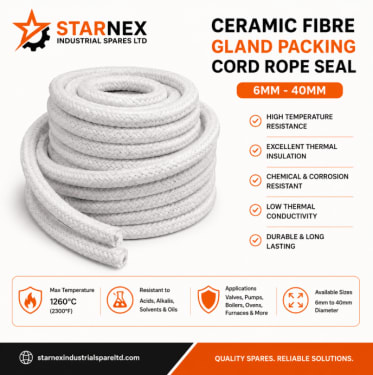
- •Pack expansion joints firmly with high-density **ceramic fiber square rope** (12 mm, 20 mm, or 25 mm). The flexible ceramic fiber compresses smoothly as the bricks expand, maintaining a flame-tight seal that prevents hot gases reaching the steel casing.
Sourcing Boiler Refractories at STARNEX Nairobi
STARNEX Industrial Spares supplies certified refractory materials and boiler masonry consumables from our Enterprise Road warehouse in Nairobi.
Our inventory includes:
- •High-Duty & High-Alumina Firebricks: Standard straights ($230\text{ mm} \times 115\text{ mm} \times 75\text{ mm}$ and $65\text{ mm}$), wedge bricks, arch bricks, and circle bricks in 42%, 60%, and 70% alumina grades.
- •High-Temperature Refractory Mortars: Air-setting and heat-setting wet bonding mortars rated to 1600°C.
- •Ceramic Fiber Packing Ropes: Square and round braided ceramic ropes (6 mm to 40 mm) for expansion joints and boiler door gaskets.
- •High-Alumina Refractory Castables: 1400°C and 1600°C dense castable concretes.
For professional refractory design advice, expansion joint calculations, and same-day delivery across East Africa, contact the STARNEX engineering team via WhatsApp at +254 740 459 672.