SMK Business Center · Enterprise Road, NairobiEnterprise Rd, Nairobi
+254 740 459 672sales@starnexindustrialspares.comEmail
STARNEX Industrial Spares Ltd
Products
Categories
Brands
ResourcesBlog
Engineering Library/How to Identify Hydraulic Hose Fittings: BSP vs NPT vs JIC Thread Standards
Technical Summary

Hydraulic Hose Fitting Identification (BSP vs NPT vs JIC) provides technical maintenance guidelines and component selection criteria for plant engineers and procurement teams in Kenya. Understanding equipment operational principles, common failure modes, and accurate part number identification ensures long service life and reliable plant operation. Consult STARNEX for technical assistance and Nairobi trade counter stock availability.

Ask Engineering TeamWhatsApp Technical Support
Hydraulics & Fittings•Technical / Engineer•18 Aug 2026•8 min read

How to Identify Hydraulic Hose Fittings: BSP vs NPT vs JIC Thread Standards

Mating an NPT male fitting into a BSPP female port is the fastest way to strip machine threads and cause a high-pressure oil leak. Here is how to use a vernier caliper and pitch gauge to positively identify BSP, NPT, and JIC hydraulic fittings.

Key Practical Takeaways

  • •Never identify hydraulic fittings by visual guessing; thread diameters between British (BSP), American (NPT), and SAE (JIC) differ by mere fractions of a millimeter but have incompatible thread profiles.
  • •Parallel threads (BSPP / G and JIC / UN) maintain a constant outer diameter along their entire length; tapered threads (BSPT / R and NPT) narrow toward the nose at a standardized taper rate of 1:16.
  • •BSP threads feature a 55° Whitworth flank angle with rounded crests and roots; NPT and JIC threads feature a 60° flank angle with flattened crests and roots—forcing them together destroys female ports.
  • •JIC (Joint Industry Council) fittings seal purely on a 37° metal-to-metal flared cone, not on the threads; wrapping Teflon tape around JIC threads will not stop leaks and shreds into hydraulic valves.
  • •BSPP male fittings seal via an elastomeric bonded Dowty seal or O-ring on the flat shoulder face; BSPT and NPT seal on the thread flanks through mechanical interference and anaerobic thread paste.
In This Technical Guide
  • §The 4-Step Systematic Identification Workflow
  • §Master Thread Comparison Matrix: BSP vs. NPT vs. JIC
  • §The Three Sealing Methods: Where Does the Oil Seal?
  • §1. Shoulder Face Seal (BSPP / ISO 1179-1)
  • §2. Cone Flare Seal (JIC 37° / SAE J514)
  • §3. Thread Flank Interference Seal (BSPT & NPT)
  • §Summary of Common Hydraulic Fitting Standards in Kenya
  • §Sourcing Hydraulic Hose Fittings at STARNEX Nairobi

In any industrial maintenance workshop across Kenya, few tasks cause more frustration, wasted time, and sheared metal threads than identifying hydraulic hose fittings.

A maintenance technician removes a leaking high-pressure hose from an injection moulding machine, an excavator, or an industrial press, drives to the nearest supplier, glances at the fitting, and declares: "I need a half-inch hydraulic hose!"

He returns to the plant, begins threading the new male fitting into the hydraulic valve manifold, and finds that it turns one or two threads by hand before seizing tight. He grabs a two-foot pipe wrench, forces it another full turn, feels the threads strip out, and when the pump starts at 210 bar (3,000 psi), high-pressure hydraulic oil sprays across the factory floor in a dangerous atomized fog.

What happened? The machine had a British BSPP port. The supplier sold him an American NPT fitting. Both measure approximately 21 mm on the outside diameter, and both are colloquially called "half-inch." But their thread pitch, flank angle, and sealing mechanics are completely incompatible.

Positively identifying hydraulic fittings is not guesswork. It requires three simple tools: a vernier caliper, a thread pitch gauge, and an understanding of the three dominant industrial thread standards: BSP, NPT, and JIC.


The 4-Step Systematic Identification Workflow

Whenever you hold an unknown hydraulic fitting in your hand, follow this exact four-step diagnostic procedure:

                  THE 4-STEP FITTING IDENTIFICATION PROCESS:

   STEP 1: Parallel or Tapered?
   └── Measure caliper OD at thread nose vs thread base.
       ├── Identical OD ────────► PARALLEL (BSPP, JIC, Metric)
       └── Increasing OD ───────► TAPERED (BSPT, NPT)

   STEP 2: Measure Thread Pitch
   └── Align pitch gauge leaves to find Threads Per Inch (TPI) or Metric Pitch (mm).
       ├── 11, 14, 19, or 28 TPI ────────► Likely BSP (55°)
       ├── 11.5, 14, 18, or 27 TPI ──────► Likely NPT (60°)
       └── 12, 14, 16, 18, or 20 TPI ────► Likely JIC (UNF 60°)

   STEP 3: Measure Caliper Outside / Inside Diameter
   └── Compare caliper millimeter readings against the Master Reference Table.

   STEP 4: Identify the Sealing Seat Mechanism
   └── Inspect where the hydraulic fluid is actually contained.
       ├── Flat Face with Dowty Washer ──► BSPP (G)
       ├── Thread Flank Interference ────► BSPT (R) or NPT
       ├── 37° Flared Cone Nose ────────► JIC 37° (SAE J514)
       └── 60° Inverted Cone ───────────► BSPP Cone Seat

Master Thread Comparison Matrix: BSP vs. NPT vs. JIC

Use this comprehensive engineering reference table to match your caliper measurements:

Nominal SizeBSPP (G) / BSPT (R) [55°]NPT [60°]JIC 37° (UNF) [60°]
1/4"13.1 mm OD (19 TPI)13.7 mm OD (18 TPI)11.1 mm OD (7/16-20 TPI)
3/8"16.6 mm OD (19 TPI)17.1 mm OD (18 TPI)14.3 mm OD (9/16-18 TPI)
1/2"20.9 mm OD (14 TPI)21.3 mm OD (14 TPI)19.0 mm OD (3/4-16 TPI)
5/8"22.9 mm OD (14 TPI)—22.2 mm OD (7/8-14 TPI)
3/4"26.4 mm OD (14 TPI)26.7 mm OD (14 TPI)27.0 mm OD (1-1/16-12 TPI)
1"33.2 mm OD (11 TPI)33.4 mm OD (11.5 TPI)33.3 mm OD (1-5/16-12 TPI)
1-1/4"41.9 mm OD (11 TPI)42.1 mm OD (11.5 TPI)41.3 mm OD (1-5/8-12 TPI)
1-1/2"47.8 mm OD (11 TPI)48.3 mm OD (11.5 TPI)47.6 mm OD (1-7/8-12 TPI)

Notice the trap: In 1/2" nominal size, a BSP thread measures 20.9 mm at 14 TPI; an NPT thread measures 21.3 mm at 14 TPI! A difference of only 0.4 mm. By eye, they look identical. But the thread flank angle is 55° on BSP and 60° on NPT. Forcing them together ruins both threads.


The Three Sealing Methods: Where Does the Oil Seal?

The biggest misconception in fluid power maintenance is that all threaded fittings seal on their threads. In reality, modern high-pressure hydraulics uses three completely different sealing mechanisms:

                  THE THREE HYDRAULIC SEALING METHODS:

   1. SHOULDER SEAL (BSPP)          2. CONE FLARE SEAL (JIC)        3. THREAD FLANK SEAL (NPT)
        [ Bonded Dowty Ring ]           [ 37° Metal Cone Nose ]         [ Metal Interference ]
           ┌───┐   ┌───┐                  \                 /             ╱ ╱ ╱ ╱ ╱ ╱ ╱
     ══════╡   ╞═══╡   ╞══════             \   37° Cone    /             ╲ ╲ ╲ ╲ ╲ ╲ ╲
           └───┘   └───┘                    \             /             Tapered Wedging
      Flat Face Crushes Washer           Metal-to-Metal Seat            Requires Anaerobic Sealant

1. Shoulder Face Seal (BSPP / ISO 1179-1)

BSPP (parallel) male threads do not seal on the threads. A smooth, flat undercut shoulder sits behind the last thread. A bonded Dowty washer (a steel ring with an internal bonded nitrile or Viton rubber lip) or an O-ring sits against this shoulder. When the fitting is torqued into the port, the rubber crushes against the flat manifold face, creating a leak-proof seal up to 400 bar.

2. Cone Flare Seal (JIC 37° / SAE J514)

JIC fittings feature straight Unified National Fine (UNF) threads. The threads do not seal anything; their only job is to generate mechanical clamping force. The male fitting has an external 37° cone nose; the female swivel fitting has an internal matching 37° flared cup.

When the swivel nut is tightened, the two precision cones wedge together metal-to-metal. Under high pressure, the cone expands, tightening the seal.

CRITICAL WARNING — TEFLON TAPE: Never put Teflon tape on JIC threads! Teflon tape does not touch the 37° sealing cone. It merely fills thread roots, prevents proper torque clamping, and shreds into the oil, clogging servo valves and hydraulic filters.

3. Thread Flank Interference Seal (BSPT & NPT)

Tapered threads (NPT and BSPT) seal directly on the helical spiral of the thread flanks. As the male fitting is screwed in, the taper causes the crests of the male thread to wedge into the roots of the female thread.

Because microscopic clearances remain at the root-crest interface, tapered threads always require a chemical anaerobic pipe sealant (such as Loctite 567 or Loctite 577). Teflon tape can be used on low-pressure pneumatic lines, but under 200 bar hydraulic shocks, tape frequently tears or extrudes.


Summary of Common Hydraulic Fitting Standards in Kenya

  • •BSPP (British Standard Pipe Parallel): Standard on European machinery, UK equipment, agricultural tractors, and industrial power packs. Designated by the letter 'G' (e.g. G 1/2").
  • •BSPT (British Standard Pipe Taper): Common on older Japanese and British hydraulic valves and plumbing manifolds. Designated by the letter 'R' for male and 'Rc' for female.
  • •NPT (National Pipe Taper): Standard on American equipment (Caterpillar, Parker, Eaton, John Deere). 60° thread angle; requires anaerobic sealant.
  • •JIC 37° (Joint Industry Council): The universal standard for mobile hydraulics, mining machinery, injection moulding lines, and earthmoving plant in East Africa. UNF thread with a 37° metal sealing cone.

Sourcing Hydraulic Hose Fittings at STARNEX Nairobi

STARNEX Industrial Spares supplies a complete inventory of high-pressure hydraulic hose ends, male and female adapters, bonded Dowty washers, and custom-crimped hose assemblies from our central Enterprise Road counter in Nairobi.

To ensure you receive the exact drop-in fitting on the first visit:

  1. 1Bring the old fitting or hose assembly to our trade counter.
  2. 2Or send clear caliper measurements of thread OD and thread pitch via WhatsApp to +254 740 459 672.

Our technical team provides professional thread identification and same-day dispatch across Kenya, Uganda, and Tanzania.
ST
STARNEX Technical Team
Fluid Power & Hydraulic Systems Specialist

Hydraulic hose assembly, high-pressure fittings, thread identification, and fluid power system design for manufacturing, earthmoving, and processing plants.

Frequently Asked Engineering Questions

No. While a 1/2" NPT male fitting can sometimes thread 1 or 2 turns into a 1/2" BSP female port, the threads are fundamentally incompatible. BSP uses a 55° Whitworth thread flank angle with 14 threads per inch (TPI), whereas NPT uses a 60° thread flank angle with 14 TPI. The thread pitch profiles clash, cross-threading and destroying the softer metal manifold. Under high hydraulic pressure (200 to 350 bar), cross-threaded fittings blow out with explosive force.

Use a digital or dial vernier caliper to take two outside diameter (OD) measurements on the male threads: measure across the crests at the first thread nearest the nose, and then measure across the crests at the last thread nearest the hex body. If both measurements are identical, the thread is Parallel (such as BSPP or JIC). If the measurement at the back is noticeably larger (increasing by approximately 1 mm for every 16 mm of length), the thread is Tapered (such as BSPT or NPT).

JIC fittings do not seal on their threads. The threads exist solely to provide mechanical clamping force. The actual fluid seal is formed when the 37° machined cone nose of the male fitting presses metal-to-metal into the 37° flared seat of the female swivel nut. Wrapping Teflon tape around the threads does nothing to seal the 37° cone interface; instead, shreds of Teflon tape break off under high velocity and contaminate sensitive proportional valves and pump suction ports.

Both are British Standard Pipe threads sharing a 55° flank angle. BSPP (British Standard Pipe Parallel, designated by the letter 'G') has straight, parallel threads along its entire length and seals using an external bonded Dowty seal or O-ring against a machined flat face. BSPT (British Standard Pipe Taper, designated by the letter 'R') has tapered threads (1:16 taper) and seals directly on the thread flanks through metal-to-metal interference, requiring an anaerobic liquid pipe sealant.

Bring the old hose assembly or metal adapter directly to our Enterprise Road counter in Nairobi. If sending measurements via WhatsApp (+254 740 459 672), provide: 1. Exact thread caliper OD measurement in millimeters (e.g. 20.9 mm or 26.4 mm). 2. Thread pitch count using a pitch gauge or ruler (threads per inch). 3. The internal seat angle (inspect whether it has a 60° cone, a 37° flare, an O-ring groove, or a flat face).

Need Technical Sourcing or Part Verification?

Contact the STARNEX technical sales desk in Nairobi for exact model verification, voltage compatibility check, and same-day dispatch quote.

Submit RFQWhatsApp Technical Desk

Related Spare Parts Stocked at STARNEX

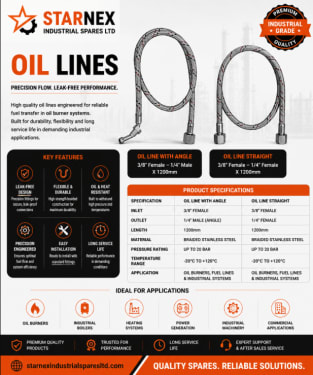
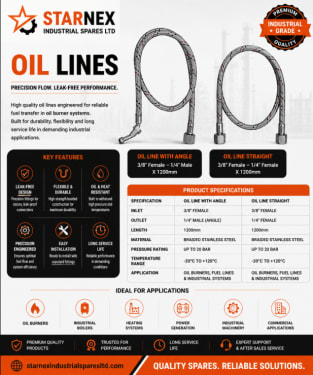
Oil Line Angle Connector 3/8" Female × 1/4" Male × 1200mm
Generic · fuel pumps

Oil Line Angle Connector 3/8" Female × 1/4" Male × 1200mm

MPN: OL-ANG-38F-14M-1200
In stock
View
Oil Line Straight 3/8" Female × 1/4" Female × 1200mm
Generic · fuel pumps

Oil Line Straight 3/8" Female × 1/4" Female × 1200mm

MPN: OL-STR-38F-14F-1200
In stock
View
Riello Oil Line Angle 3/8" Female × 1/4" Male × 1200mm
Riello · assorted accessories

Riello Oil Line Angle 3/8" Female × 1/4" Male × 1200mm

MPN: RIE-OL-ANG-1200
In stock
View
Parker PGP511A0190CA1H2ND5D3B1B1 Hydraulic Gear Pump
Parker · industrial pumps

Parker PGP511A0190CA1H2ND5D3B1B1 Hydraulic Gear Pump

MPN: PGP511A0190CA1H2ND5D3B1B1
In stock
View

Related Engineering Guides

Hydraulic Filtration

Selecting Hydraulic Filters for High-Dirt Factory Environments: Micron & Beta Ratios

Over 75% of hydraulic pump and proportional valve failures are caused by fluid contamination. In dusty cement, tea, and grain processing environments, choosing the correct micron rating and Beta ratio is vital to prevent catastrophic component seizure.

Read guide
Burners & Combustion

Why Burner Fuel Pumps Lose Pressure: Troubleshooting Suntec & Danfoss Failures

When an industrial boiler trips on low fuel pressure, the pump is usually the first suspect. Here is how to diagnose gear cavitation, clogged strainers, and shaft seal leaks on Suntec and Danfoss pumps before replacing components.

Read guide
STARNEX Industrial Spares Ltd

Industrial spare parts supplier. Genuine OEM components for burners, pumps, bearings, valves, and automation systems across Kenya and East Africa.

SMK Business Center, Enterprise Road, Industrial Area, Nairobi
About Us·Company Profile (PDF)·Trade Counter
Products
  • Burners & Nozzles
  • Fuel Pumps & Solenoids
  • Industrial Pumps
  • Motors & VFDs
  • All Categories →
Resources
  • Engineering Articles
  • V-Belt Calculator
  • Bearing Tolerance Chart
  • Thread Identification
  • Company Profile (PDF)
Contact
+254 740 459 672sales@starnexindustrialspares.com

Mon–Sat: 8:00 AM – 5:00 PM

© 2026 STARNEX Industrial Spares LtdNairobi, Kenya · KRA PIN: P052208035D